PSLE AL Scoring System Explained

Each PSLE subject (English, Maths, Science, Mother Tongue) is graded into one of eight Achievement Levels, AL1 to AL8, based only on the raw mark. Your child's PSLE Score is the sum of the four subject ALs, ranging from 4 (best) to 32. A lower score is better. Foundation subjects are graded A to C and mapped to AL6 to AL8 for the total.
Since 2021, the PSLE has been scored with Achievement Levels (ALs) instead of the old T-score aggregate. The idea is simple once you see it: each subject gets a band from 1 to 8, and your child’s PSLE Score is just the sum of four bands. The confusing part for most parents is that a lower score is better.
The AL bands
Each of the four subjects — English, Mathematics, Science and Mother Tongue — is graded into one of eight ALs, using the same reference table for every subject:
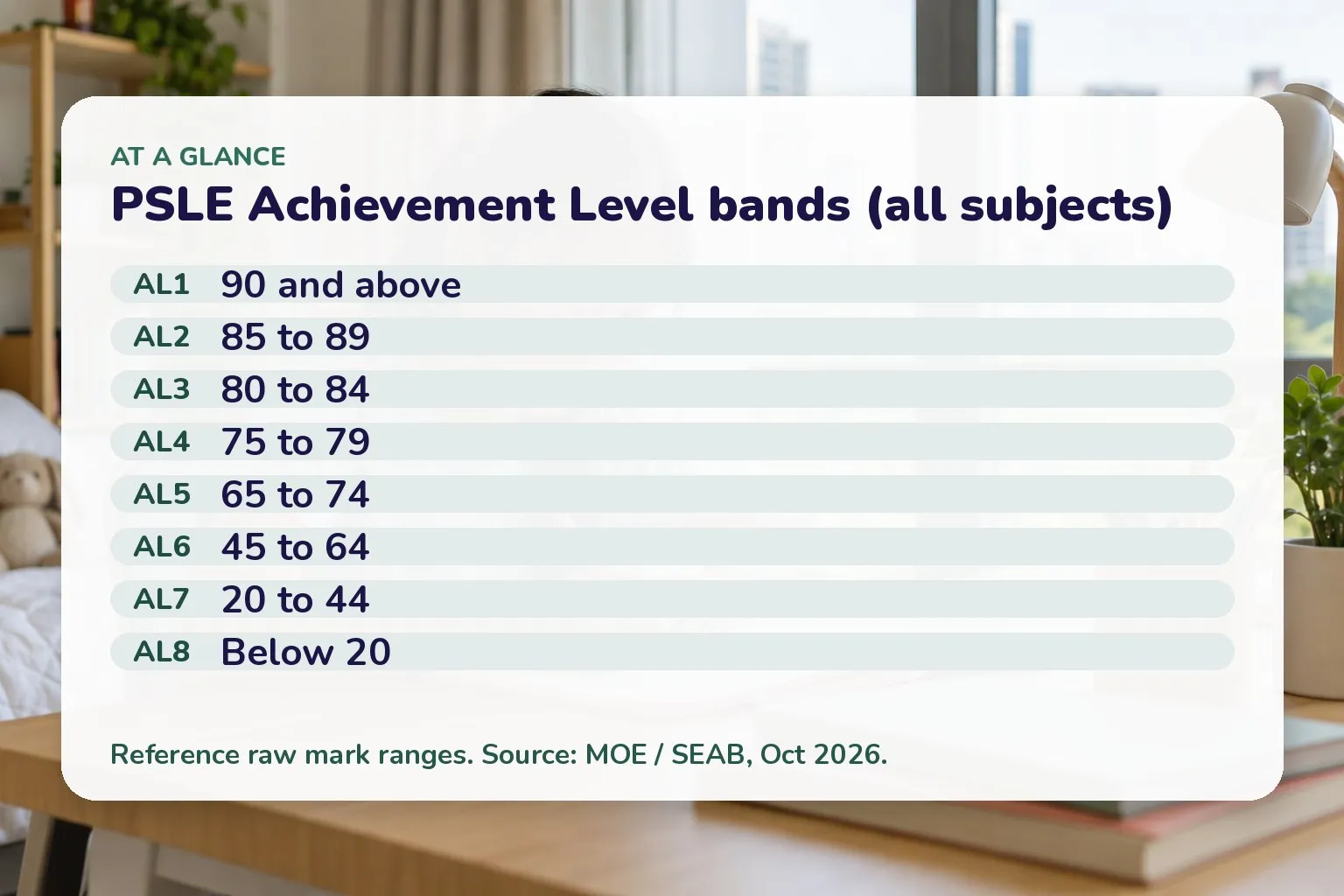
The same band table applies to all four subjects. Source: MOE.
| Achievement Level | Reference raw mark |
|---|---|
| AL1 | 90 and above |
| AL2 | 85 – 89 |
| AL3 | 80 – 84 |
| AL4 | 75 – 79 |
| AL5 | 65 – 74 |
| AL6 | 45 – 64 |
| AL7 | 20 – 44 |
| AL8 | Below 20 |
Notice the bands are uneven. AL1 to AL4 each span about five marks, while AL6 covers twenty marks and AL7 covers twenty-five. The top is finely graded; the middle and lower ranges are deliberately broad, so small differences do not separate students.
How the PSLE Score is built
Your child’s PSLE Score is the sum of the four subject ALs. The best possible score is 4 (AL1 in all four subjects); the range runs up to 32 (AL8 in all four). For example:
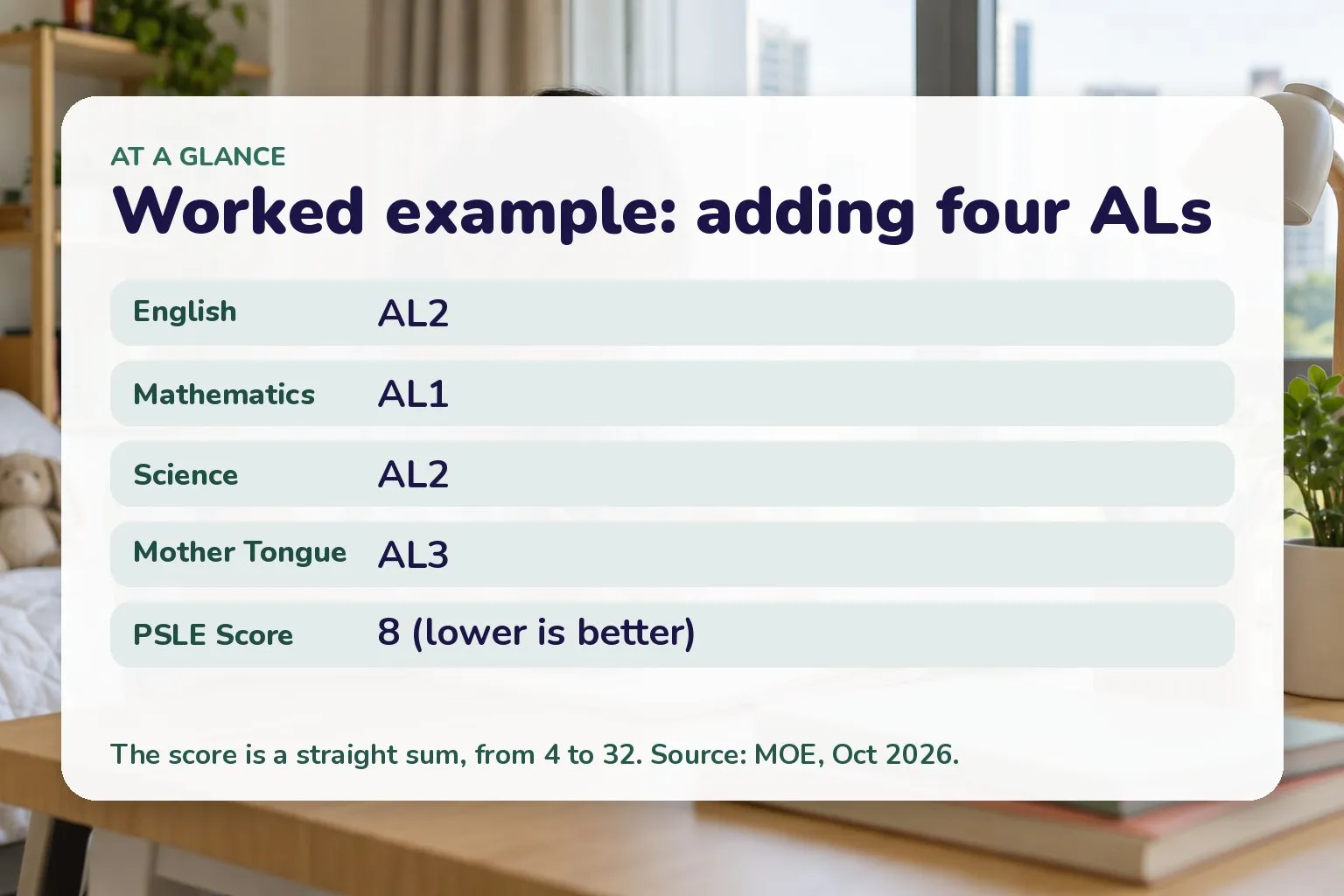
Illustrative. PSLE Score is the sum of the four subject ALs. Source: MOE.
| Subject | AL |
|---|---|
| English | AL2 |
| Mathematics | AL1 |
| Science | AL2 |
| Mother Tongue | AL3 |
| PSLE Score | 8 |
There is no weighting between subjects and no cohort-relative adjustment — it is a straight sum. Our PSLE AL score calculator does this for you.
Why a lower score is better
Because the score adds up bands where AL1 is the best, a smaller total means stronger performance. A PSLE Score of 6 is better than 12. This trips up parents used to “higher is better” from percentages, so it is worth saying plainly: aim low.
Foundation subjects
Students taking Foundation-level subjects are graded A, B or C rather than AL1–AL8. For the purpose of the total PSLE Score and Secondary 1 posting, these grades are mapped to Standard-level ALs:
| Foundation grade | Foundation raw mark | Counts as |
|---|---|---|
| A | 75 – 100 | AL6 |
| B | 30 – 74 | AL7 |
| C | Below 30 | AL8 |
What the score is for
The PSLE Score decides your child’s Posting Group and is the main basis for Secondary 1 posting. It does not map to a single school — posting also depends on your choice order and vacancies. Read how cut-off points actually work before you read too much into any one number, and see how the score feeds Full Subject-Based Banding.
A note on revision
Because the bands are uneven, the marginal mark matters most near a boundary. A child on 84 (AL3) who reaches 85 gains a whole AL; a child comfortably mid-band gains nothing in AL terms from a few more marks. That is a reason to focus effort where a child is close to crossing a band, not to chase marks everywhere.
General information based on MOE and SEAB sources, not official guidance. Confirm current rules on moe.gov.sg and seab.gov.sg.
Sources
- How will the current PSLE scoring system benefit your child? — Ministry of Education Singapore (as of October 2026)
- Singapore Examinations and Assessment Board (PSLE) — Singapore Examinations and Assessment Board (as of October 2026)