How PSLE Cut-Off Points Actually Work

A school's cut-off point (COP) is the PSLE Score of the last student posted into that school in a given Posting Group that year. It is a historical record, not a target set in advance, so it shifts a few points year to year with demand. Meeting last year's COP does not guarantee a place, because tie-breakers still apply.
“Cut-off point” sounds like a fixed entry requirement set by each school. It is not. A PSLE cut-off point (COP) is a record of what happened last year — the PSLE Score of the last student who was posted into a school in a given Posting Group. Understanding this one fact removes most of the anxiety around COPs.
What a COP really is
When Secondary 1 posting finishes, MOE notes, for each school and each Posting Group, the PSLE Score of the last student who got in. That number is the COP. Because it depends entirely on that year’s cohort and their choices, it is a result of the exercise, not a quota decided in advance.
MOE publishes each year’s COPs in December, after posting. The ranges you see in SchoolFinder are based on the previous year’s cohort.
Three things that follow
COPs move. As demand for a school rises or falls, its COP can shift by a few points from one year to the next. Last year’s number is a guide, not a guarantee.
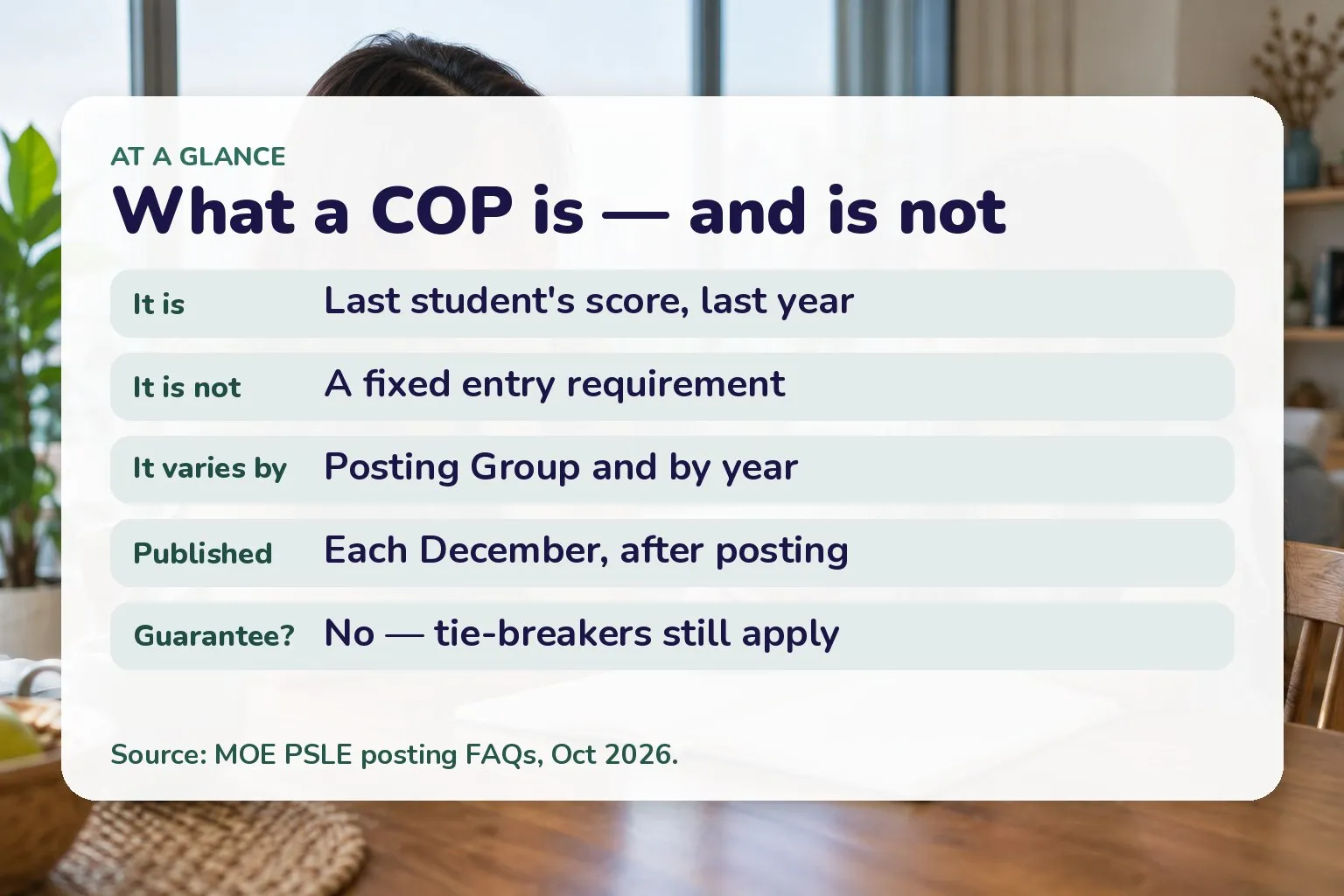
A COP is a historical result, not a target. Source: MOE.
A COP is not an entry requirement. Meeting last year’s COP does not secure a place this year. If more strong applicants rank the school, the effective cut-off tightens.
COPs differ by Posting Group. A school that admits students across Posting Groups will have a different COP for each one, because Full Subject-Based Banding posts students through Posting Groups 1, 2 and 3.
Why meeting the COP is not enough
Even if your child’s PSLE Score matches a school’s past COP, they may not be posted there. When two or more students with the same PSLE Score compete for the last place, MOE applies tie-breakers in order: citizenship, then choice order of schools, then computerised balloting. So not everyone who meets the COP gets in — see how posting works.
How to use COPs sensibly
MOE’s own advice when shortlisting is clear:
- Treat published COPs as a reference, based on last year.
- Include at least two or three schools where your child’s PSLE Score is better than the school’s previous COP.
- Use all six choices, and rank your genuinely preferred schools higher.
That way, a normal year-to-year wobble in a COP does not leave your child without a strong option. What a COP cannot tell you is whether a school fits your child — for that, look at programmes, CCAs and distance, not the number.
What we will never do
We do not publish or predict per-school cut-off points ourselves. The only reliable COPs are MOE’s own published figures each December; anything else is guesswork, and guessing a child’s future on an invented number is exactly what this site avoids.
General information based on MOE sources, not official guidance. Check official COPs and dates on moe.gov.sg.
Sources
- FAQs — PSLE Scoring System (posting and COP) — Ministry of Education Singapore (as of October 2026)
- Shortlisting schools (S1 Posting) — Ministry of Education Singapore (as of October 2026)