DSA-Sec: How Direct School Admission Works

DSA-Sec lets Primary 6 students seek a secondary place before PSLE, based on a talent such as a sport, art or academic area. You apply online for free with up to three school-and-talent choices, attend the schools' selection, and get outcomes by late August. If allocated a school, your child must still sit the PSLE and cannot join S1 posting.
Direct School Admission for secondary schools (DSA-Sec) is a route for Primary 6 students to seek a place in certain secondary schools before the PSLE, based on a specific talent — a sport, a performing or visual art, a uniformed group, leadership, or an academic strength. It is optional, free, and does not replace the PSLE.
Who it is for
DSA-Sec suits a child with a demonstrable talent that a particular school is looking for. Each participating school sets its own talent areas and its own selection process. It is not a general “get in early” scheme — schools select for the specific strengths they offer programmes in.
How to apply
Applications are made online through the DSA-Sec Portal, using one parent’s Singpass, and there is no fee.
- You may indicate up to three choices.
- Each choice is a school plus a talent area.
- A maximum of two of your three choices may be for the same school (different talent areas).
For the 2026 exercise (admission to secondary school in 2027), applications ran from 6 May to 2 June 2026. The window recurs around the same time each year — confirm the exact dates on MOE’s site.
Selection and outcomes
After applying, shortlisted students attend each school’s trials, auditions or interviews, generally from late June to late August. Schools inform applicants of the result directly. There are three possible outcomes:
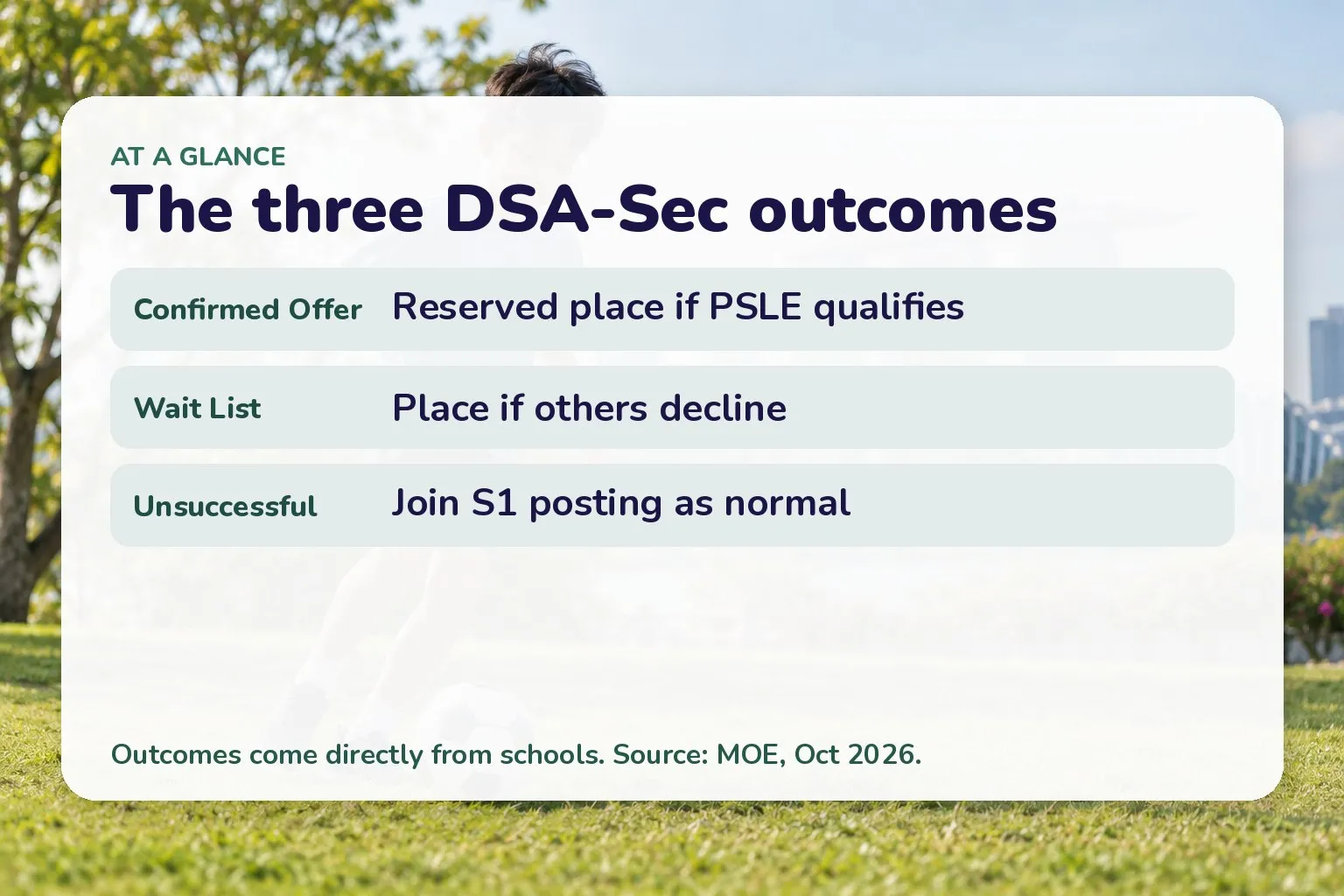
A confirmed offer still needs a qualifying PSLE score. Source: MOE.
| Outcome | What it means |
|---|---|
| Confirmed Offer | A reserved place, if your child meets a PSLE score within a Posting Group the school offers. |
| Wait List | A place may open if confirmed-offer students decline; in past years about half of wait-listed students were eventually placed. |
| Unsuccessful | No DSA place; the child takes part in S1 posting as normal. |
For the 2026 exercise, outcomes were released by 28 August 2026.
Confirming your school
Students with a Confirmed Offer or Wait List place then submit their school preferences (up to three) in a set October window — for 2026, from 19 to 23 October 2026. School allocation is released together with the PSLE results. An offer not taken up lapses at the end of this window.
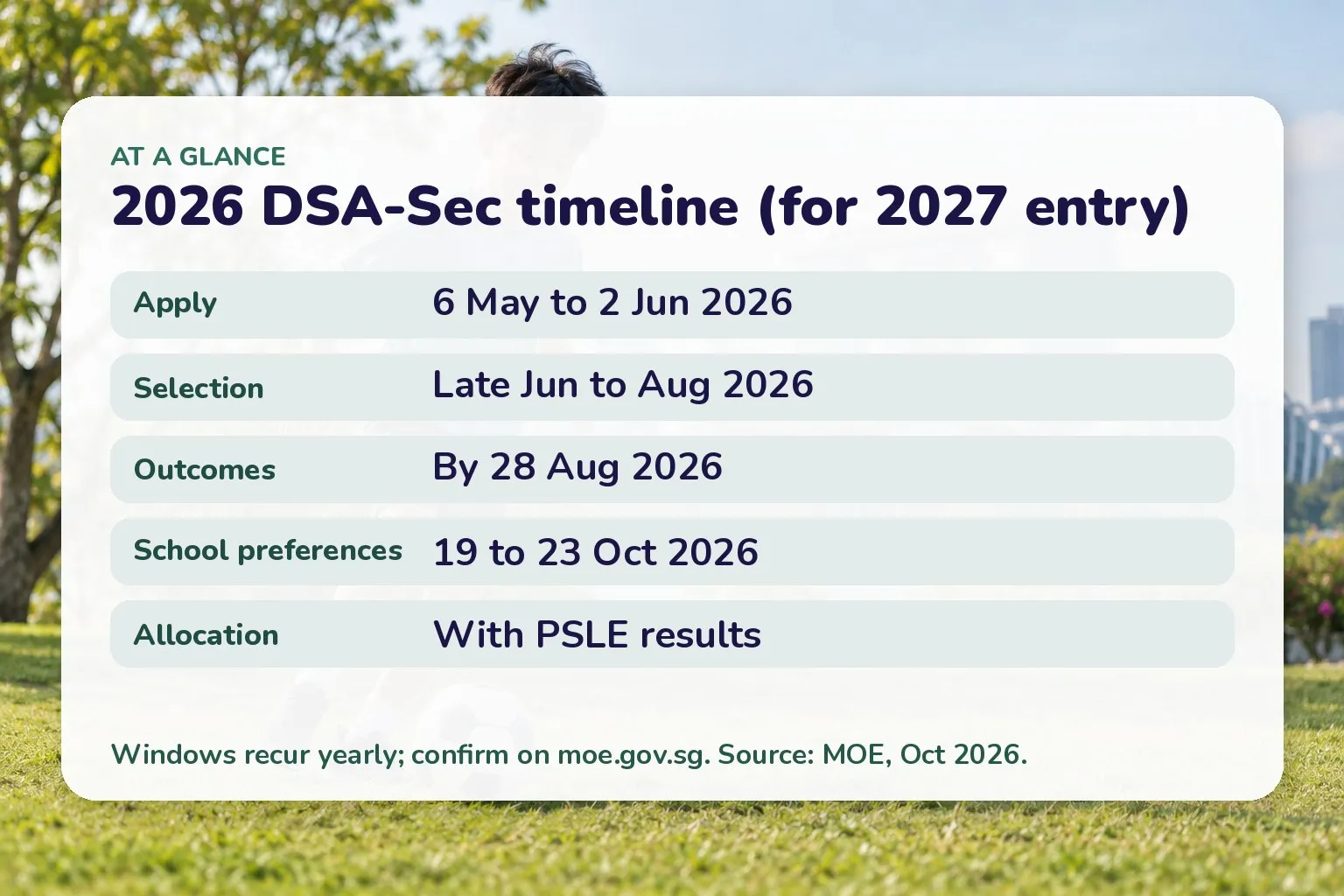
The 2026 exercise windows, for 2027 secondary entry. Source: MOE.
The commitment — read this carefully
DSA is a genuine commitment. If your child is allocated a school through DSA-Sec:
- They must still sit the PSLE and achieve a PSLE score that qualifies them for a Posting Group the school offers. For example, if a school offers only Posting Group 3, the child needs a PSLE Score of 4–22. Understand this through our guide to Full Subject-Based Banding and AL scoring.
- They cannot take part in S1 posting.
- They cannot transfer to another school after the PSLE results.
Is DSA right for your child?
DSA can be a good fit for a child with a real, developed talent and a clear interest in a school’s programme. It is not a shortcut around the PSLE, and the no-transfer commitment means the choice should be deliberate. If your child does not have a specific talent a school is seeking, the normal posting route is perfectly good.
General information based on MOE sources, not official guidance. Confirm current windows and rules on moe.gov.sg.
Sources
- Direct School Admission for secondary schools (DSA-Sec) — Ministry of Education Singapore (as of October 2026)
- DSA-Sec: Attend interviews or auditions (selection outcomes) — Ministry of Education Singapore (as of October 2026)
- Start of 2026 Direct School Admission Exercises (press release) — Ministry of Education Singapore (as of October 2026)