O-Level to JC: L1R5, Cut-Off and the ELR2B2 Myth

Junior college admission uses the L1R5 aggregate, not ELR2B2 (that is for polytechnic). You need an L1R5 gross score of 20 or lower, plus set subject grades; bonus points then cut it to the net score used for posting.
On this page11 sections · tap to jump
- 01ELR2B2 is for polytechnic, not JC
- 02How L1R5 is built
- 03The subject-grade requirements
- 04Bonus points and the net aggregate
- 05The cut-off that actually matters
- 06If you just miss: conditional admission
- 07DSA-JC: a place before the O-Levels
- 08Millennia Institute: the three-year route
- 09A worked example (illustrative)
- 10What changes from the 2028 exercise
- 11Frequently asked questions
If you are moving from the O-Levels to a junior college (JC), the number that decides your place is the L1R5 aggregate. Many families search for “ELR2B2 JC” — but ELR2B2 is the polytechnic aggregate, not the JC one. This guide clears up that mix-up and walks through exactly how JC admission works: the score you need, the subject grades, bonus points, how the “cut-off” is set, and what changes from 2028.
ELR2B2 is for polytechnic, not JC
Here is the single most common confusion. To be eligible for a JC course through the Joint Admissions Exercise (JAE) or DSA-JC in 2027, your L1R5 gross aggregate score must not exceed 20. The ELR2B2 aggregate — which must not exceed 26 — is used for polytechnic diploma courses, not JC. (The Diploma in Nursing is the usual polytechnic exception, allowing an ELR2B2-C net aggregate up to 28.)
For both aggregates, a lower score is better — it means stronger results across the subjects that count.
How L1R5 is built
L1R5 is your first language plus five relevant subjects:
- L1 — English Language, or Higher Mother Tongue Language.
- R1 — one best-scoring Humanities subject.
- R2 — one best-scoring Mathematics or Science subject.
- R3 — one more best-scoring subject from Humanities, Mathematics or Science.
- R4 and R5 — your two next best-scoring subjects.
You add the six grade points together to get the gross aggregate. Religious Knowledge cannot be used as one of the scoring subjects, and you cannot use both Higher Mother Tongue and Mother Tongue of the same language in the same computation.
The subject-grade requirements
Clearing the aggregate alone is not enough. You must also hit minimum grades in three specific subjects, whatever your total:
| Subject | Grade needed |
|---|---|
| English Language | A1 to C6 |
| One Mathematics (Additional or Elementary) | A1 to D7 |
| One Mother Tongue Language | A1 to D7 (Higher MTL: A1 to E8; ‘B’ syllabus: Merit or Pass) |
Marks became grades earlier in the journey at the PSLE — for a refresher on how that scoring works, see PSLE AL scoring explained.
Bonus points and the net aggregate
Bonus points are subtracted from your L1R5 gross aggregate to give the net aggregate score that JAE actually uses for posting. You can earn a maximum of 4 bonus points from any combination of:
- CCA grade from a national secondary school: “Excellent” = 2 points, “Good” = 1 point.
- English and Higher Mother Tongue both at A1–C6 = 2 points (also Chinese/Malay (Special Programmes) or Bahasa Indonesia at A1–C6).
- Affiliated JC selected as your first choice = 2 points (applies to that choice only).
A further 2 points apply if you are admitted to a Chinese, Malay or Tamil Language Elective Programme at a JC and offer that subject at A-Level.
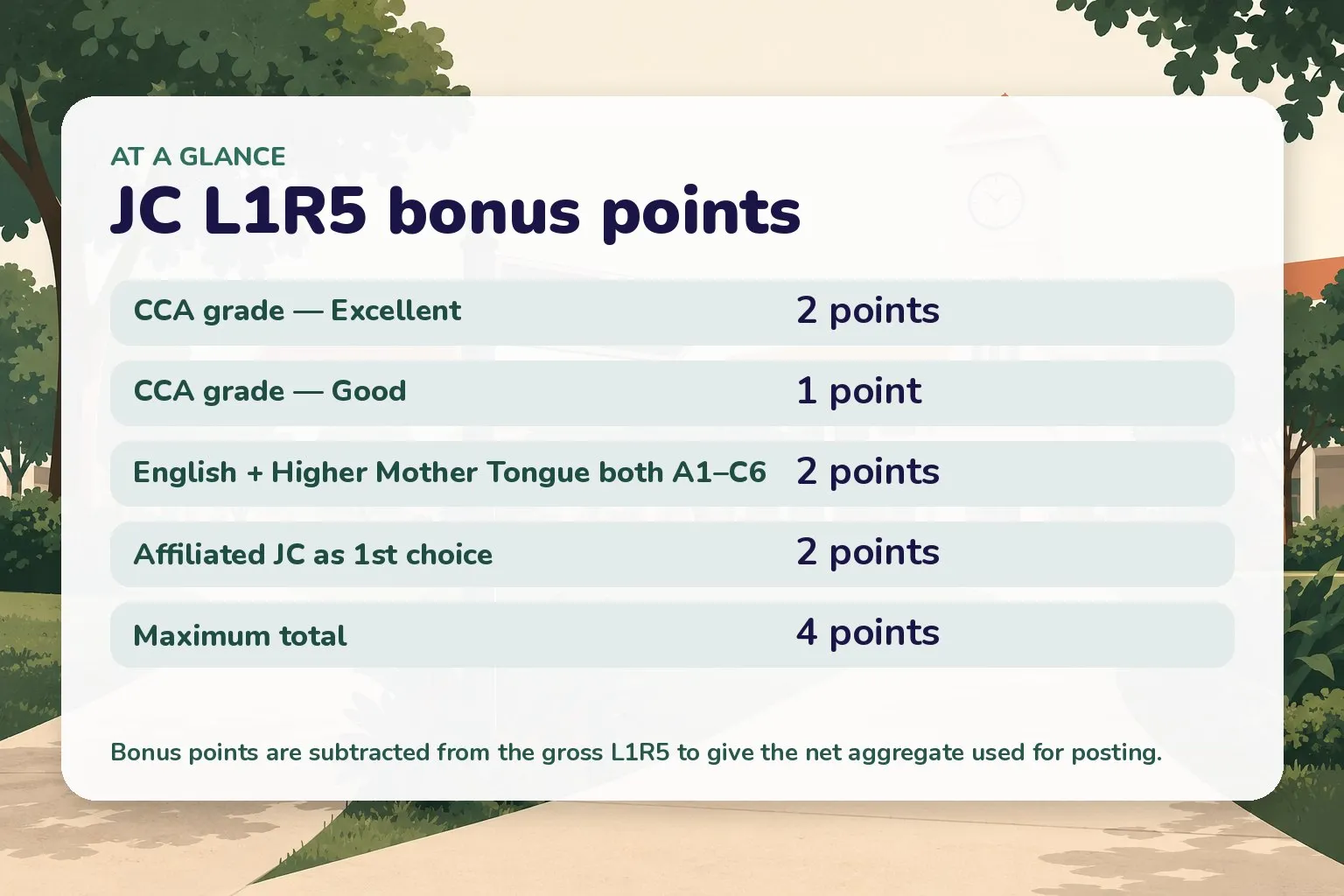
Bonus points are subtracted from the gross L1R5 to give the net aggregate. Source: MOE, as of October 2026.
The cut-off that actually matters
A JC “cut-off point” is simply the net L1R5 aggregate of the last student posted to a course in a given year — it is not a fixed target set in advance. Because posting is by merit against that year’s applicants and their choices, the figure moves from year to year.
MOE’s SchoolFinder shows each course’s recent net-aggregate range, but it states plainly that these are a reference only and do not guarantee admission; the ranges for the 2027 JAE are updated on results-release day. So treat published cut-offs as a guide to where you stand, not a promise.
If you just miss: conditional admission
If your aggregate qualifies but you fall short on one of the three specific subject grades, you may still be admitted conditionally when:
- your L1R5 gross aggregate is 15 or lower, or
- it is 16 to 20 and you have A1 or A2 in all five relevant subjects.
An “Absent” grade in a specific subject rules out conditional admission.
DSA-JC: a place before the O-Levels
Direct School Admission for junior colleges (DSA-JC) lets you apply to a JC before the O-Levels, based on talent in sports, CCAs or specific academic areas that exams may not show. It is a separate, talent-based route — not part of JAE.
Two things to understand before you accept an offer:
- Your DSA-JC place is confirmed only if you still qualify for JC admission on your O-Level results (you must meet the L1R5 and subject requirements).
- If you accept and keep a DSA-JC offer, you cannot take part in JAE and cannot transfer to another school.
In the 2026 cycle, Phase 1 selection ran from 29 June to 11 August 2026, offers were accepted by 14 August, the deadline to cancel an acceptance (to re-enter JAE) was 7 October 2026, and allocation outcomes arrive by email on O-Level results day in January 2027. For how DSA-JC sits alongside the results-based exercises, see JAE, EAE and DAE explained.
Millennia Institute: the three-year route
Millennia Institute (MI) offers a three-year A-Level course and admits on an L1R4 aggregate (your L1 plus four relevant subjects) of 20 or lower — a wider door than the two-year JC. It is also where conditionally admitted JC students transfer if they do not clear a subject in Year 1. MI suits students who want the A-Level path with a little more runway.
A worked example (illustrative)
The numbers below are illustrative, to show the method — not a real student or a predicted cut-off.
Suppose a student has: English B3 (3), a Humanities subject B3 (3), Mathematics A2 (2), a Science B4 (4), and two more best subjects at A2 (2) and B3 (3). The L1R5 gross aggregate is 3 + 3 + 2 + 4 + 2 + 3 = 17. With a “Good” CCA grade (1 point) and English plus Higher Mother Tongue both at A1–C6 (2 points), 3 bonus points are subtracted, giving a net aggregate of 14. That clears the L1R5 ≤ 20 bar comfortably; whether it wins a specific course depends on that year’s cut-off in SchoolFinder.
What changes from the 2028 exercise
The rules tighten under the new Post-Secondary Admissions (PSE) framework.
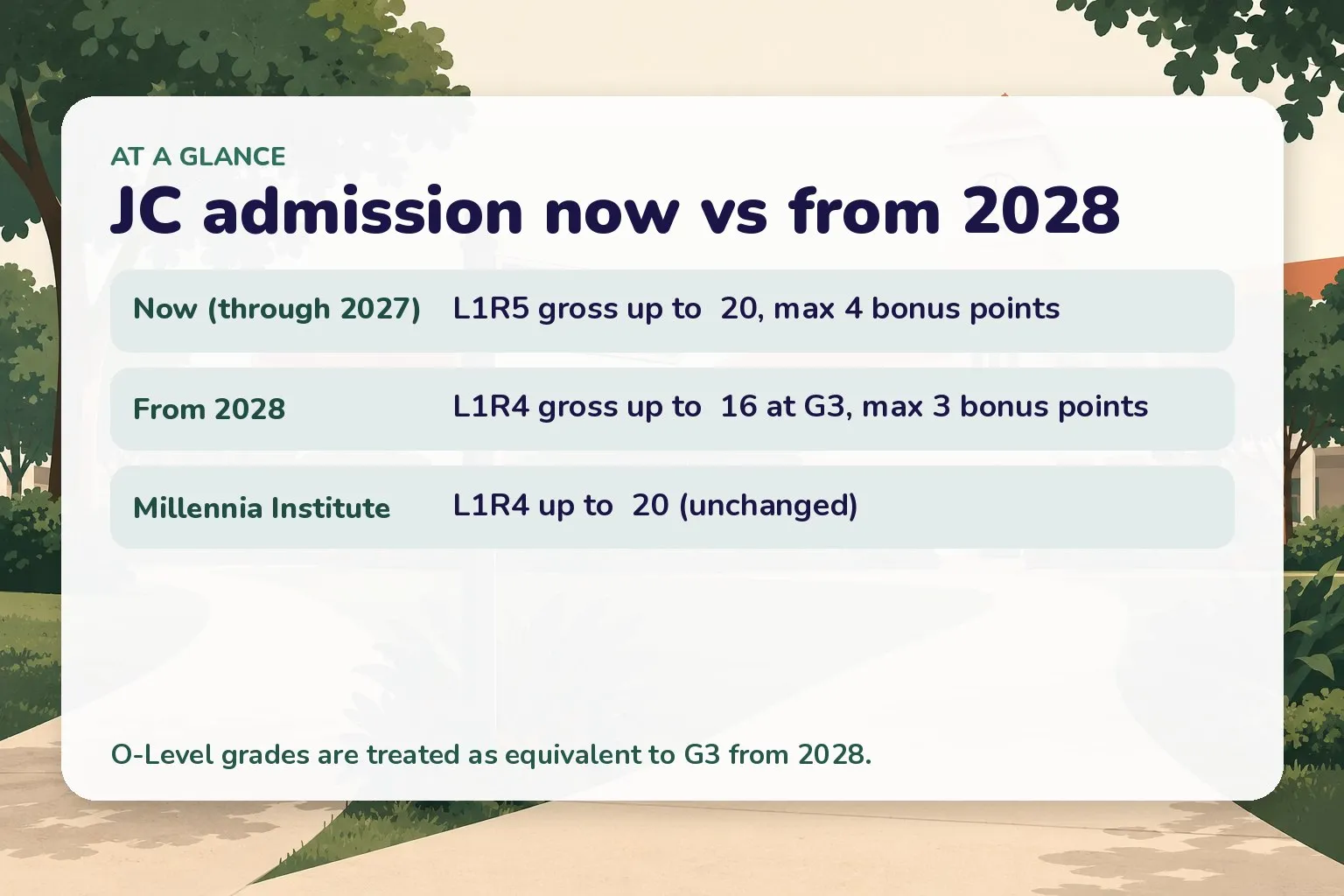
How the JC bar changes under the 2028 PSE framework. Source: MOE, as of October 2026.
Frequently asked questions
Is ELR2B2 ever used for JC? No. JC uses L1R5; ELR2B2 is for polytechnic diploma courses. Confusing the two is the most common mistake families make.
What score do I need for JC? An L1R5 gross aggregate of 20 or lower (net, after bonus points, is what posting uses), plus the English, Mathematics and Mother Tongue grade requirements.
Where do I find a JC’s cut-off? In MOE’s SchoolFinder, as a reference range updated on results day — not a fixed, guaranteed number.
What happens if I accept a DSA-JC offer and change my mind? You can cancel the acceptance by the published deadline (7 October in the 2026 cycle) to take part in JAE; otherwise you are committed to the DSA-JC school.
General information based on MOE sources, not official guidance or admissions advice. Confirm the aggregates, subject requirements, cut-offs and dates for your cohort on moe.gov.sg.
Sources
- Joint Admissions Exercise (JAE): Admissions matters of JCs and MI — Ministry of Education Singapore (as of October 2026)
- Joint Admissions Exercise (JAE): Polytechnic admission and courses — Ministry of Education Singapore (as of October 2026)
- Direct School Admission for junior colleges (DSA-JC): Overview — Ministry of Education Singapore (as of October 2026)
- Post-Secondary Admissions (PSE): JC and MI (from 2028) — Ministry of Education Singapore (as of October 2026)