P1 Registration Phases in Singapore Explained

P1 registration runs in order through five phases for citizens and PRs — 1, 2A, 2B, 2C and 2C Supplementary — with international students only in Phase 3. Each phase has its own eligibility, from sibling to open-to-all, and you register at one school per phase. If a school is oversubscribed, citizenship and home-school distance decide priority.
Primary 1 (P1) registration is how you enrol a Singapore Citizen (SC) or Permanent Resident (PR) child into a mainstream primary school for the following year. It runs online in a fixed sequence of phases, each with its own eligibility criteria. You register at only one school in any phase, and if you are unsuccessful you move to the next phase your child is eligible for.
The five phases, in order
For SC and PR children, registration moves through five phases. International students are considered only afterwards, in Phase 3.
| Phase | Who it is for |
|---|---|
| Phase 1 | A child with a sibling currently studying in the school. |
| Phase 2A | A child whose parent or sibling is a former student of the school; whose parent is a member of the School Advisory/Management Committee; whose parent is a staff member; or who is from the MOE Kindergarten located within the school. |
| Phase 2B | A child whose parent is a qualifying parent volunteer; whose parent is endorsed by a church or clan connected with the school; or whose parent is an endorsed active community leader. |
| Phase 2C | Open to all children with no prior connection to the school. |
| Phase 2C Supplementary | A child not yet registered in any school after Phase 2C. |
Phase 2A combines what used to be separate alumni and staff phases into one. Parent-volunteer eligibility in Phase 2B has conditions attached — broadly, joining the school as a volunteer by 1 July of the year before registration and giving at least 40 hours of service by 30 June of the registration year. Always confirm the current criteria on MOE’s page before relying on them.
How reserved places work
Every school sets aside reserved places so that children without connections still have a route in. Under the current framework, 20 places are reserved for Phase 2B and 40 for Phase 2C — 60 in total. After Phase 2A, one-third of any remaining vacancies flow to Phase 2B and two-thirds to Phase 2C.
When a phase is oversubscribed
If a school receives more applicants than it has places, admission is decided first by citizenship (SCs before PRs) and then by home-school distance — within 1km, between 1km and 2km, and beyond 2km. Balloting is used only within the category where places run out. This distance priority applies from Phase 2B onwards. The full order and worked examples are in our guide to home-school distance priority.
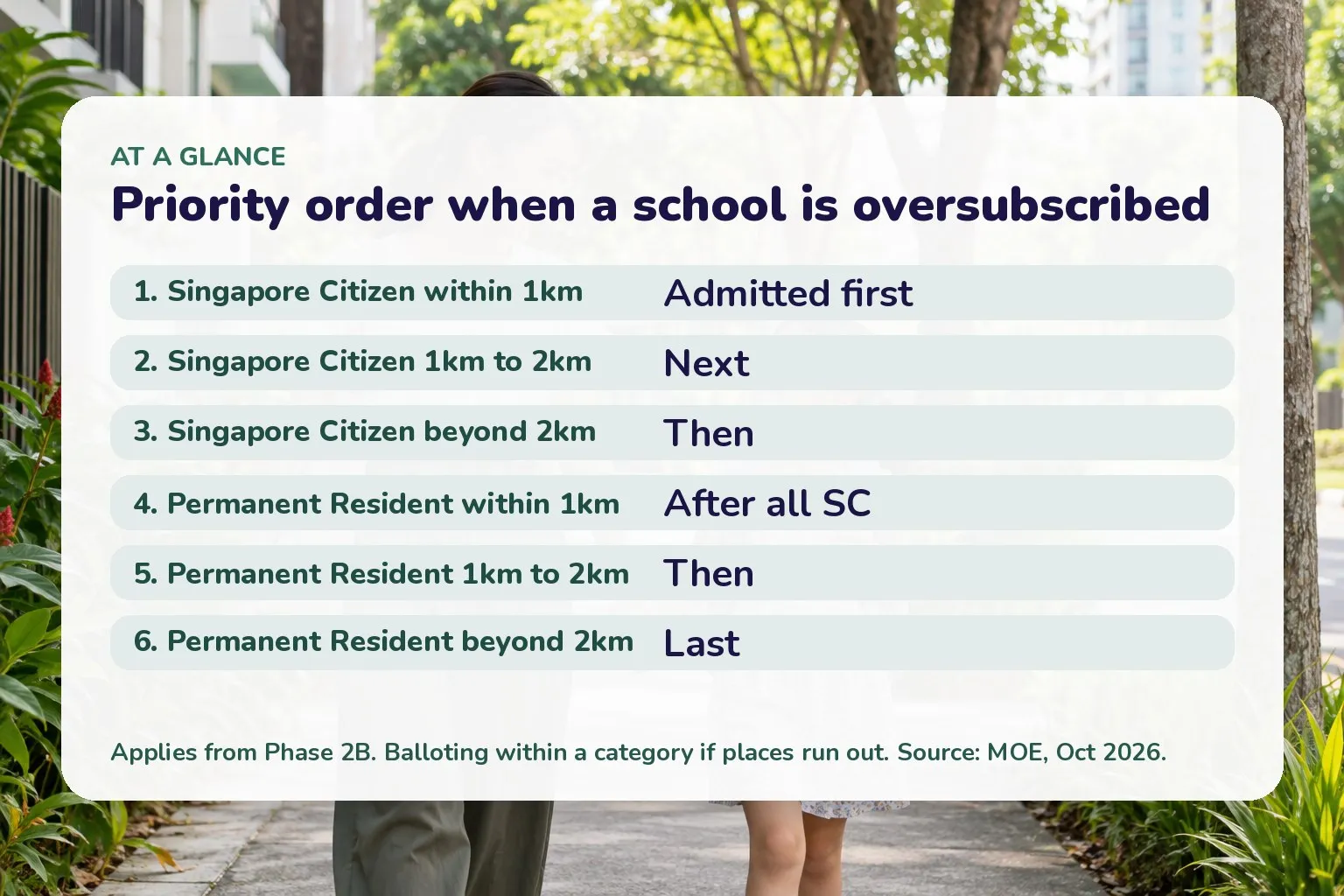
Citizenship first, then home-school distance. Source: MOE.
Key dates (2026 exercise)
Dates shift slightly each year. For the 2026 exercise, Phase 1 ran from 30 June to 2 July 2026 (results on 8 July), and Phase 2C Supplementary ran from 17 to 18 August 2026 (results on 27 August). The phases in between fall across July and early August. Check MOE’s “Registration phases and key dates” page for the exact window of each phase in your registration year.
A few rules worth remembering
- One school per phase. Multiple applications are not accepted; MOE takes your latest submission within the phase.
- Unsuccessful is not the end. If you miss out in one phase, you can register in the next phase your child qualifies for. A child still unregistered after Phase 2C Supplementary is posted to a school with vacancies.
- Distance is measured officially. It runs from the school’s land boundary to your home, using the registered address — see how home-school distance works.
Changes from 2027
MOE has announced a revised P1 Registration Framework starting from the 2027 exercise (for children starting P1 in 2028). The changes include more reserved Phase 2C places at most schools and new arrangements for some two-track schools. If your child starts P1 in 2028 or later, read MOE’s revised framework rather than this year’s rules.
Next steps
- Work out your eligibility early and decide on a preferred school before the window opens.
- If you have no prior tie to a school, focus on Phase 2C and read how to choose a primary school using official data.
- Understand the distance rule, since it decides most balloting — see home-school distance priority.
General information based on MOE sources, not official guidance. Confirm every date and rule on moe.gov.sg for your registration year.
Sources
- Primary 1 (P1) registration — Ministry of Education Singapore (as of October 2026)
- Registration phases and key dates of P1 registration — Ministry of Education Singapore (as of October 2026)
- How distance affects priority admission for P1 registration — Ministry of Education Singapore (as of October 2026)