Types of Secondary Schools in Singapore
Singapore's secondary schools fall into five main categories: government, government-aided, independent, specialised independent, and specialised schools. The first two follow the national curriculum at standardised fees; independent and specialised ones set their own fees and offer distinctive or talent-focused programmes.
On this page12 sections · tap to jump
- 01The five main categories
- 02Government and government-aided schools
- 03Autonomous status (not a separate type)
- 04SAP schools
- 05Independent schools
- 06Specialised independent schools
- 07Specialised schools and PG1 schools
- 08What each type costs
- 09How admission differs by type
- 10Type vs pathway (SEC and IP)
- 11The landscape in numbers
- 12Frequently asked questions
“What type of school is it?” is one of the first questions parents ask when shortlisting secondary schools. In Singapore the answer is really about how a school is funded and run — which shapes its fees, its freedom to design programmes, and sometimes how you apply. Here are the five categories, plus the extra labels (autonomous, SAP) that sit on top of them.
The five main categories
MOE groups schools by how they are governed and funded:
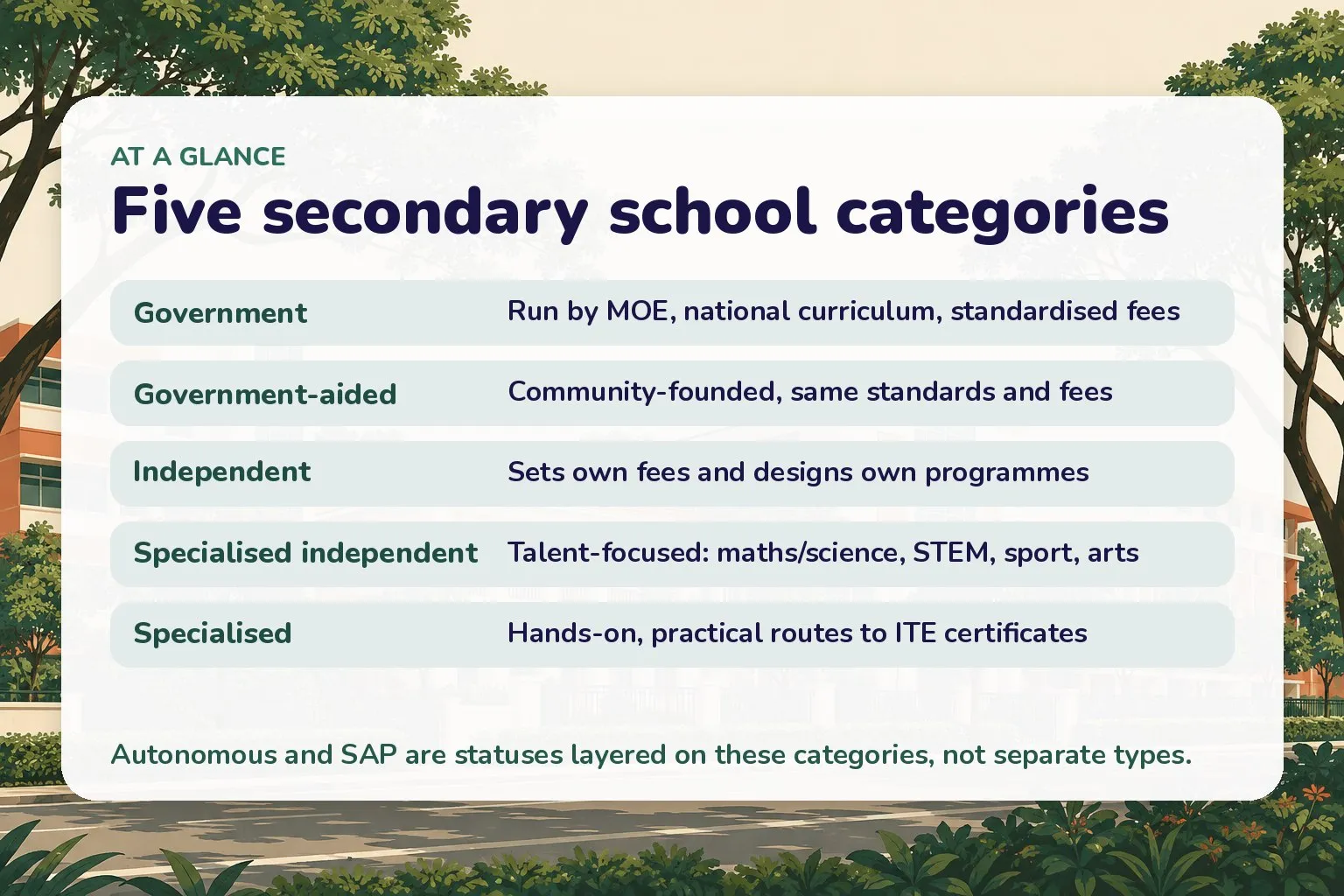
The five categories by how each school is funded and run. Source: MOE, as of October 2026.
- Government schools — run by MOE, national curriculum, standardised fees.
- Government-aided schools — set up by community organisations, same standards and standardised fees as government schools.
- Independent schools — freedom to set their own fees and design their academic and non-academic programmes.
- Specialised independent schools — talent-focused schools for maths and science, applied STEM, sport or the arts.
- Specialised schools — customised, hands-on routes for students suited to practical, experiential learning.
Government and government-aided schools
These are the backbone of the system and, for most families, the default. Government schools are run directly by MOE. Government-aided schools were founded by community, clan or religious organisations and are supported by MOE; they keep the same education standards and charge the same standardised fees as government schools. In day-to-day terms the experience is very similar — the historical difference is who founded and helps manage the school.
Both follow the national curriculum. Since the 2024 Secondary 1 cohort, the old Express, Normal (Academic) and Normal (Technical) streams have been phased out; students are now posted through Posting Groups 1, 2 and 3 and take subjects at levels G1, G2 or G3 under Full Subject-Based Banding.
Autonomous status (not a separate type)
Some government and government-aided schools also hold autonomous status. This is not a sixth category — an autonomous school still follows the national syllabus, but it offers a wider range of programmes to stretch and develop students’ talents. The trade-off is a small additional autonomous school fee of S$3 to S$18 a month on top of the standard fee.
SAP schools
Special Assistance Plan (SAP) schools nurture bilingual, bicultural students immersed in Chinese language and culture. A school can be a government, government-aided or independent school and an SAP school.
If your child took both English and Chinese at the PSLE, they may opt for an SAP school (Higher Chinese in primary school is not required to apply). Students who scored Pass, Merit or Distinction in Higher Chinese and have a PSLE score of 14 or better get a posting advantage for SAP schools, and those posted must take Higher Chinese or Chinese so they can take part in the school’s programmes.
Independent schools
Independent schools have the flexibility to set their own fees and to design their own academic and non-academic programmes. Most still offer the GCE O-Level or A-Level, and three independent schools also offer the International Baccalaureate (IB) Diploma Programme. Some independent schools are SAP schools too.
Because fees are not standardised, costs vary widely — check each school’s website. Singapore Citizens may be eligible for the Edusave Scholarship for Independent Schools (ESIS), the Independent School Bursary (ISB), or school-specific scholarships, so an independent school is not out of reach on fees alone.
Specialised independent schools
Specialised independent schools (SIS) offer specialised education for students with strong talent and interest in particular fields. There are four:
- NUS High School of Mathematics and Science — mathematics and science (awards its own diploma).
- School of Science and Technology — applied learning in science, technology, engineering and design.
- Singapore Sports School — sport and athletics.
- School of the Arts (SOTA) — visual, literary and performing arts.
Like independent schools, SIS set their own fees. Admission is not through the usual Secondary 1 posting: NUS High, the School of Science and Technology and SOTA admit through Direct School Admission (DSA-Sec), while the Singapore Sports School runs its own admission process — apply directly to the school.
Specialised schools and PG1 schools
A separate group serves students who learn best through practical, hands-on work:
- NorthLight School and Assumption Pathway School take students who do not qualify for a secondary course after the PSLE. Their experiential programmes lead to an ITE Skills Certificate (ISC) at the end of Year 4, opening the way to work or to ITE.
- Crest Secondary School and Spectra Secondary School are for students eligible for Posting Group 1 only or the PG1/2 Option Band. They combine G1-level subjects, selected G2 subjects and the ITE Skills Subject Certificate (ISSC) to help students discover their interests before choosing a post-secondary path.
What each type costs
Monthly school fees depend on the category and the student’s residency status. For Singapore Citizens, the standardised fees are modest:
| School type | Singapore Citizen monthly fee |
|---|---|
| Government / government-aided secondary | S$25 |
| Autonomous school (added fee) | + S$3 to S$18 |
| Crest / Spectra (specialised) | S$25 |
| Independent / specialised independent | Set by each school (varies) |
Permanent Residents and international students pay substantially higher fees, and financial assistance and merit awards are available to Singapore Citizens across the categories.
How admission differs by type
Most students enter through Secondary 1 posting on their PSLE Score — see how S1 posting works. But the route in varies by type and by how much of an intake a school can fill through Direct School Admission (DSA-Sec), the talent-based route explained in our DSA-Sec guide:
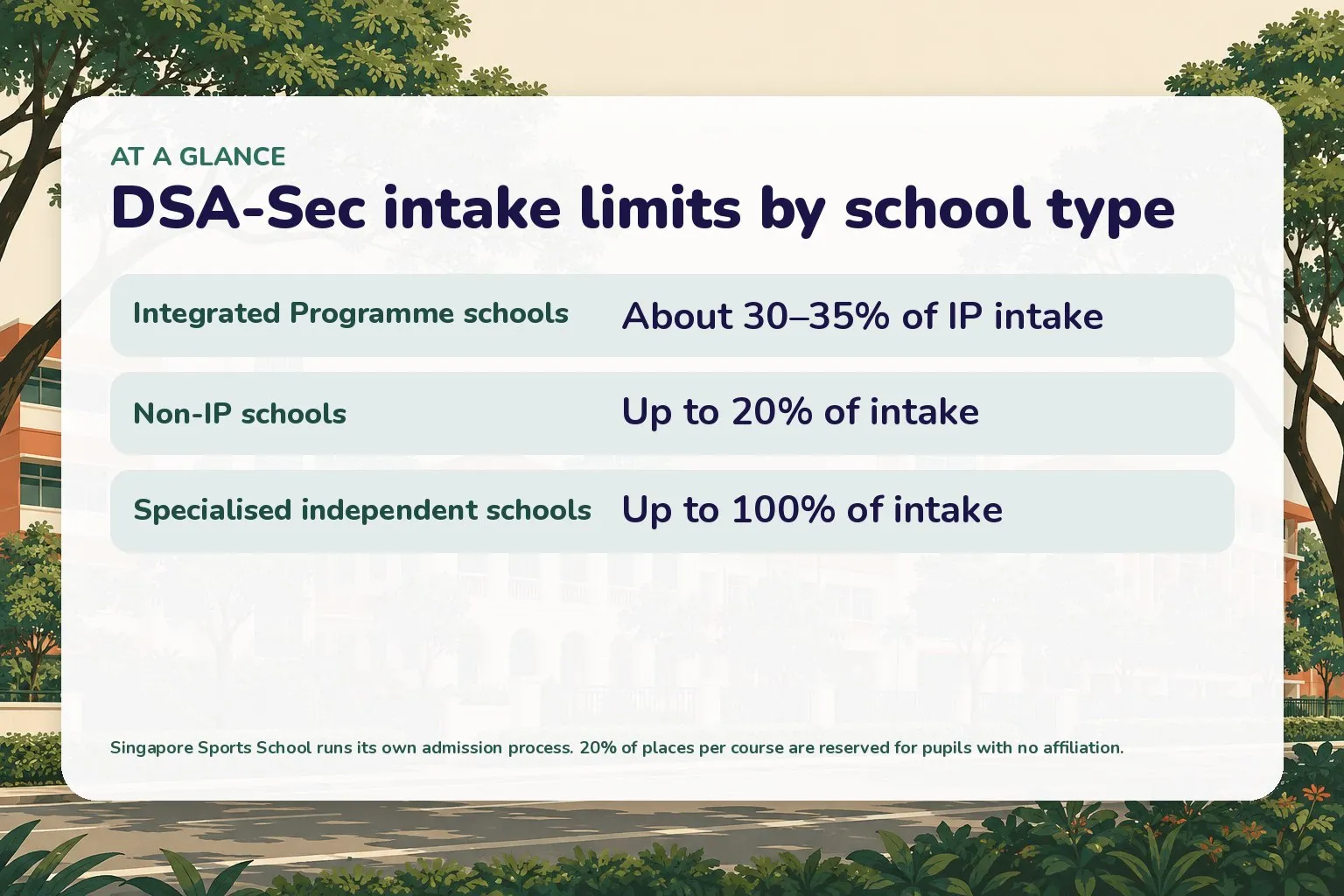
How much of an intake each type can fill through DSA-Sec. Source: MOE, as of October 2026.
- Integrated Programme (IP) schools generally admit about 30–35% of their IP intake through DSA.
- Non-IP schools can admit up to 20% of their intake through DSA.
- Specialised independent schools (NUS High, SST, SOTA) can admit up to 100% through DSA; the Singapore Sports School runs its own process.
Type vs pathway (SEC and IP)
Do not confuse a school’s type with its academic pathway. A secondary school may offer the four-year Singapore-Cambridge Secondary Education Certificate (SEC) route, the six-year Integrated Programme (IP), or both — and IP schools exist across government, government-aided and independent categories.
The SEC route runs four years (with the option of a fifth) and leads to the SEC examination; the IP runs six years, skips the SEC exam at Secondary 4, and ends in the A-Level, the IB Diploma or the NUS High School Diploma. For how the six-year route works, see Integrated Programme schools.
The landscape in numbers
MOE’s school directory on data.gov.sg lists around 130 secondary schools. The overwhelming majority are government or government-aided; only a small number are independent or specialised independent, and a handful are specialised schools. Well-known independent and IP schools include Raffles Institution, Hwa Chong Institution, Anglo-Chinese School (Independent), Nanyang Girls’ High and St Joseph’s Institution. So while the categories sound varied, most families are choosing among government and government-aided schools in their area.
Frequently asked questions
Is a government-aided school worse than a government school? No. They meet the same education standards and charge the same standardised fees; the difference is historical — who founded and helps run the school.
Does “autonomous” mean the school is better? Not inherently. Autonomous schools offer a wider range of programmes for a small extra fee; “better” depends on fit, not the label.
Can any student apply to a specialised independent school? They admit on talent through DSA-Sec (or their own process for the Sports School), so a demonstrated strength in the school’s field matters more than a posting score.
Are independent schools unaffordable? Fees are higher and school-set, but Singapore Citizens can tap the Edusave Scholarship for Independent Schools, the Independent School Bursary and school scholarships.
General information based on MOE and data.gov.sg sources, not official guidance. Confirm current fees, categories and admission details on moe.gov.sg.
Sources
- Types of schools — Ministry of Education Singapore (as of October 2026)
- Secondary 1 (S1): How to choose schools — explore schools — Ministry of Education Singapore (as of October 2026)
- Direct School Admission (DSA-Sec): Explore school choices — Ministry of Education Singapore (as of October 2026)
- General information of schools (MOE school directory) — data.gov.sg / Ministry of Education Singapore (as of October 2026)
- Social mixing in secondary schools (parliamentary reply) — Ministry of Education Singapore (as of October 2026)