MOE Programmes: ALP, LLP and Elective Programmes

Nearly every mainstream school runs two distinctive programmes — an Applied Learning Programme (ALP) and a Learning for Life Programme (LLP) — both non-examinable. Some secondary schools also offer talent-based elective programmes in music, art and languages that you enter through a selection exercise.
When a school lists its “MOE programmes”, it usually means one of two very different things: the distinctive programmes that almost every mainstream school runs for all its pupils — an Applied Learning Programme and a Learning for Life Programme — and the selective elective programmes in music, art or languages that only some schools offer and that you have to be chosen for. This guide explains both, so you can read a school profile and know what is open to every child and what is not.
Two layers: distinctive programmes and elective programmes
Think of it as a base layer and a top layer:
- Distinctive programmes (ALP and LLP) are part of the school experience for all pupils at that school. They are non-examinable and shape the character of the school rather than select pupils.
- Elective and talent programmes (the Music, Art and Language Elective Programmes, the Bicultural Studies Programme and so on) are centrally designated, offered at a limited set of schools, and entered through a selection exercise.
Applied Learning Programme (ALP)
An ALP helps pupils see the point of what they learn by applying it to the real world. MOE describes it as non-examinable, with the emphasis on applying knowledge and thinking skills — stretching the imagination and bringing lessons into authentic settings in society and industry. A school’s ALP runs for its pupils as a whole; there is no test to get in.
ALPs are grouped into broad themes, and a school picks one identity. Across the school directory, the themes break down roughly like this:
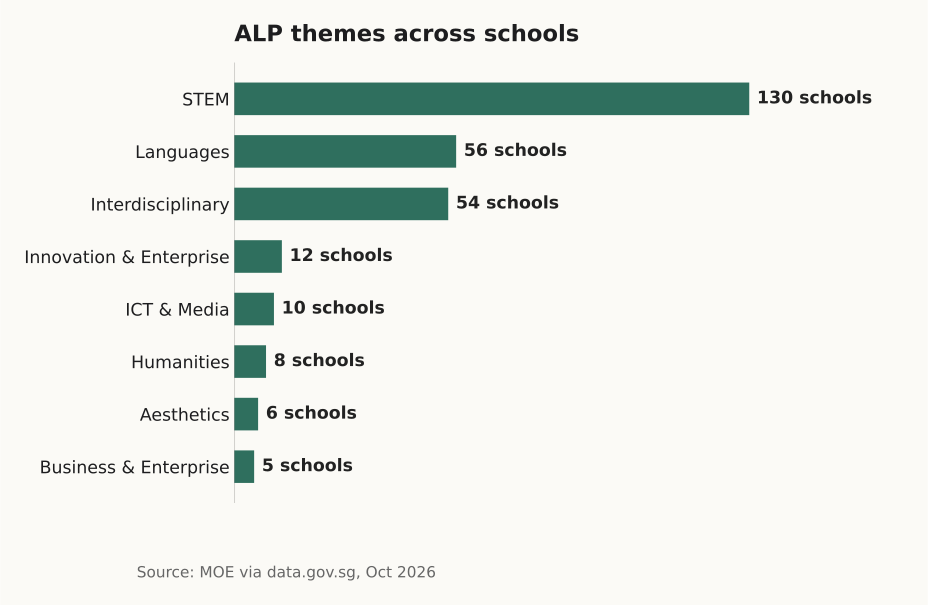
How schools’ ALP themes are distributed. Source: MOE via data.gov.sg, October 2026.
STEM is by far the most common — think design-and-make, robotics, sustainability or health science — followed by languages (drama, debate, journalism) and interdisciplinary “thinking skills” programmes. Because an ALP is woven into a school’s curriculum, it is one of the better signals of a school’s personality.
Learning for Life Programme (LLP)
Where an ALP is about applying academic learning, an LLP is about character and values. MOE’s aim for the LLP is to give pupils a sense of rootedness and responsibility for their community and fellow Singaporeans, and an appreciation of aesthetics, sport and outdoor education. Like the ALP, it is for every pupil in the school and is not examined.
Schools build their LLP around one of a few areas:
- Sports and outdoor education — the most common choice.
- Music and performing arts, or visual arts and design.
- Community and youth leadership, or community service and student leadership.
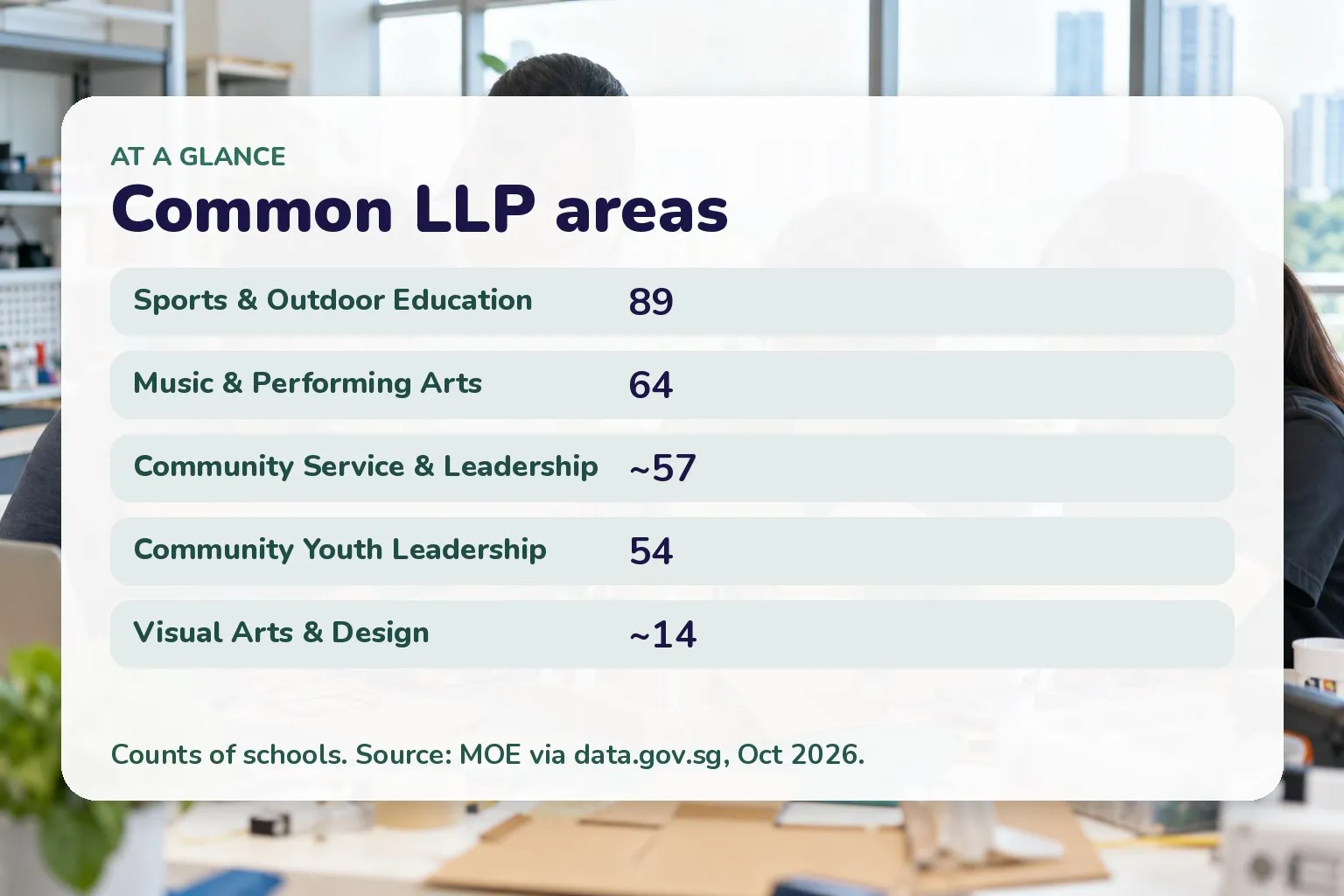
The most common LLP areas across schools. Source: MOE via data.gov.sg, October 2026.
MOE elective and talent programmes
Separately from ALP and LLP, MOE runs a set of centralised elective programmes for pupils with a strong, specific talent. Unlike the distinctive programmes, these are offered only at designated schools and you must pass a selection exercise to join. The School Directory lists the following, with the number of schools offering each:
| Programme | What it is | Schools |
|---|---|---|
| Music Elective Programme (MEP) | In-depth study of music; four years from Secondary 1 | 12 |
| Language Elective Programme (Chinese) | Deeper study of the language and literature | 11 |
| Enhanced Art Programme (EAP) | Art specialisation, lighter than the AEP | 9 |
| Language Elective Programme (Malay) | Deeper study of the language and literature | 8 |
| Art Elective Programme (AEP) | In-depth study of art; four years from Secondary 1 | 8 |
| Bicultural Studies Programme (BSP) | Biculturalism and contemporary China; Secondary 3 to JC 2 | 8 |
| Language Elective Programme (Tamil) | Deeper study of the language and literature | 5 |
| Regional Studies Programme (RSP) | Southeast Asia focus | 5 |
| Enhanced Music Programme (EMP) | Music specialisation, lighter than the MEP | 4 |
| Elective Programme in Malay Language (EMAS) | Advanced Malay at secondary | 4 |
| Language Elective Programme (English) | Deeper study of English language and literature | 3 |
| Drama Elective Programme (DEP) | In-depth study of drama | 3 |
The Music Elective Programme, for example, lets musically inclined pupils study music in depth over a four-year course from Secondary 1, and you take it only after passing the MEP selection exercise. The Art Elective Programme mirrors that for art. The Bicultural Studies Programme, introduced in 2005, is a four-year programme from Secondary 3 to JC 2 for pupils keen on biculturalism and understanding contemporary China and the West.
Alongside these, secondary schools also offer Applied Learning Modules (ApLM) — short enrichment modules focused on practical application — and a range of applied subjects such as Computing or Exercise and Sports Science. These broaden options without a separate selection exercise.
How this differs from CCAs and the GEP
Two common mix-ups are worth clearing up:
- Not a CCA. An ALP or LLP shapes curriculum and school culture; a co-curricular activity is a club or team your child joins. A school’s LLP might use sport as its vehicle, but that is still different from signing up for the netball CCA.
- Not the GEP. Elective programmes select for a developed talent in one domain; they are not the old gifted programme for all-round ability. The Gifted Education Programme itself is being discontinued in its current form and replaced by school-based support from 2027 — we cover that in full in GEP selection: how it now works.
Finding a school’s programmes
Programme offerings change, and no two schools are identical, so always check against the official record rather than a forum list.
- Use MOE’s SchoolFinder for the current ALP, LLP and elective programmes at a named school.
- Our school finder and school comparison tool are built on MOE’s own directory dataset, so you can line up two or three schools’ programmes side by side.
- For the six-year route and how talent-based admission feeds into it, see the Integrated Programme and DSA for secondary schools.
MOE programmes FAQ
Does every school have an ALP and an LLP? Mainstream government and government-aided schools do. Independent, Autonomous, IP and specialised schools run their own distinctive programmes instead.
Are ALP and LLP graded? No. Both are non-examinable and are for all pupils in the school.
How do I get into an elective programme like MEP or AEP? You apply and sit the programme’s selection exercise; places are at designated schools only, and most start at Secondary 1.
Can a child do both an elective and the ALP/LLP? Yes — the ALP and LLP are part of the school for everyone, and an elective programme is an additional specialised track for selected pupils.
Where do the school counts come from? From MOE’s School Directory and Information datasets on data.gov.sg, as of October 2026; the live figures refresh as MOE updates the data.
General information based on MOE sources, not official guidance. Confirm each school’s current programmes on moe.gov.sg.
Sources
- Applied Learning Programme (ALP) — Ministry of Education Singapore (as of October 2026)
- Learning for Life Programme (LLP) — Ministry of Education Singapore (as of October 2026)
- School-specific opportunities (secondary) — Ministry of Education Singapore (as of October 2026)
- Music Elective Programme (MEP) for secondary — Ministry of Education Singapore (as of October 2026)
- Art Elective Programme (AEP) for secondary — Ministry of Education Singapore (as of October 2026)
- Bicultural Studies Programme (BSP) — Ministry of Education Singapore (as of October 2026)
- School Directory and Information (Collection 457) — Ministry of Education via data.gov.sg (as of October 2026)