GEP Selection in Singapore: How It Now Works

The centralised GEP is being phased out. High-ability primary pupils are now identified by a single standardised Primary 3 exercise (first held August 2026) plus teachers' input, then stretched within their own school and at nearby centres — with no transfer to the nine GEP schools.
On this page8 sections · tap to jump
If you are searching for how “GEP selection” works, the honest answer in 2026 is that it is changing. The Ministry of Education (MOE) is discontinuing the Gifted Education Programme (GEP) in its current form and moving to a broader, school-based approach for higher-ability learners. The old picture — a top 1% sitting a two-round test in Primary 3 and transferring into one of nine special primary schools at Primary 4 — no longer describes what your child will go through.
What is changing, and why
The GEP was introduced in 1984 to nurture intellectually gifted pupils. Around 1% of each cohort was selected and studied at one of nine primary schools from Primary 4: Anglo-Chinese School (Primary), Catholic High School (Primary), Henry Park, Nan Hua, Nanyang, Raffles Girls’ Primary, Rosyth, St Hilda’s and Tao Nan.
MOE’s reasoning for the change is that ability develops over time and often shows up in a single area — only English, or only Mathematics — rather than across the board. Meanwhile, every primary school has built up its own capacity to stretch strong learners. So instead of moving a small group of all-rounders to a few schools, the system now aims to support more children, in more subjects, closer to home.
What replaces the GEP: two tiers of support
From 2027, support for pupils with academic strengths comes in two layers, and a child can take one or both.
- School-based provisions. Every primary school already runs in-curriculum extensions and after-school enrichment — for example Excellence 2000 (E2K) Mathematics and Science — introduced from 2007. These are being widened so that around 10% of the cohort can benefit, up from around 7% today.
- Centre-based advanced modules. Pupils who would gain from more stretch can attend weekly modules after school at a nearby designated centre. Crucially, they no longer transfer to one of the nine former GEP schools — they stay put and travel to a centre only for the module.
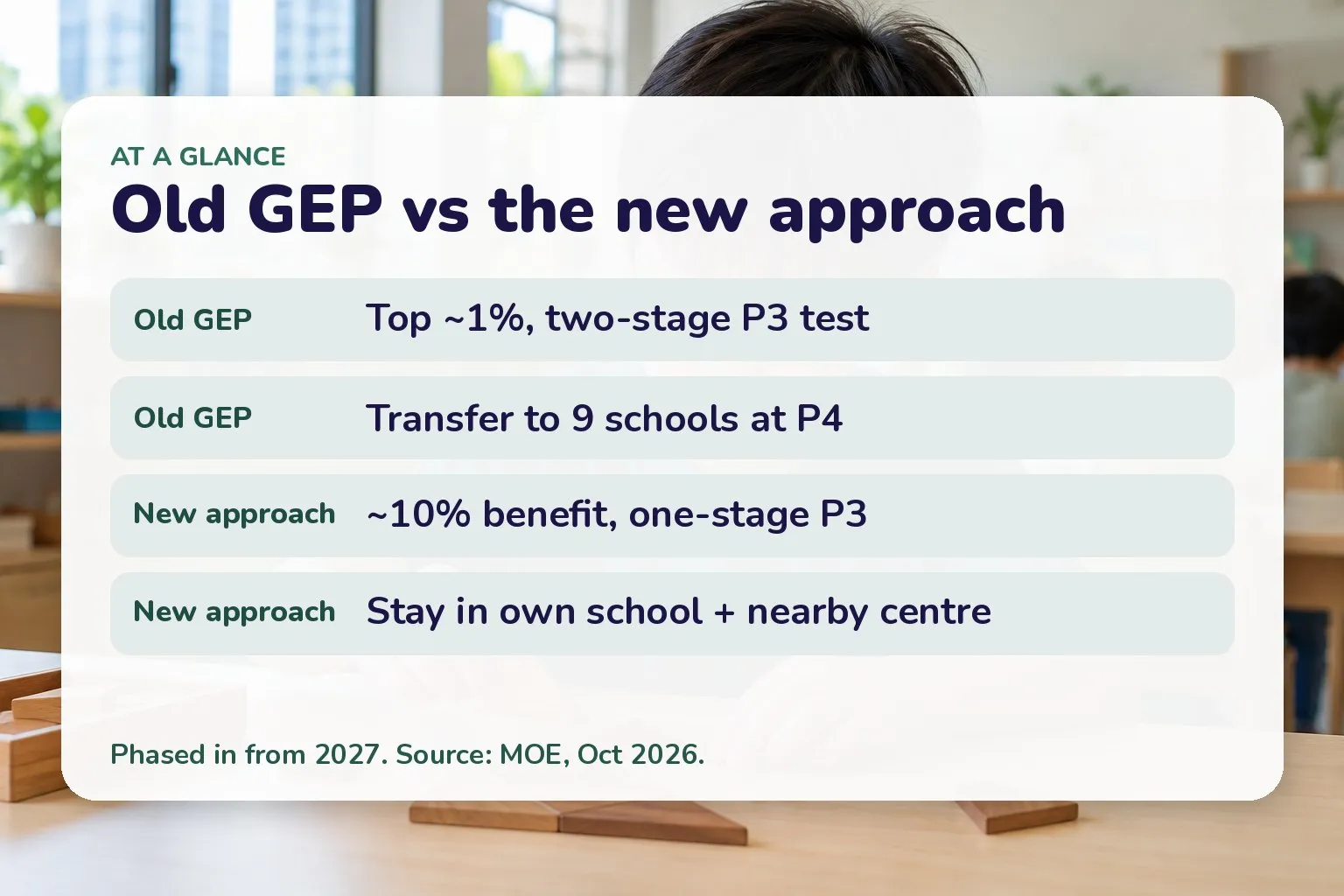
How the model changes. Source: MOE.
There are two kinds of advanced module, taught by specially trained teachers:
- Subject modules in English, Mathematics or Science — a two-hour session each week during term time, letting a child go deeper in a specific strength.
- Interdisciplinary modules — run during the school holidays, connecting subjects around a theme (a worked example MOE has cited is designing a playground, pulling in science, mathematics and social studies).
Because the modules target specific strengths rather than all-round ability, more children can take them than the old GEP admitted. Fifteen primary schools serve as designated centres, chosen for geographic spread and access by public transport; MOE says it will review that list over time.
How selection works now: one-stage identification
The defining change for parents is the test itself. The old GEP used a two-stage screening-and-selection exercise. The new process keeps only a single standardised identification exercise in Primary 3, supplemented by what schools already know about a child.
- The exercise assesses aptitude in English and Mathematics (and reasoning), rather than school syllabus content.
- Schools can also identify pupils using day-to-day observations, teachers’ input and pupils’ work — so the test is not the only yardstick.
- MOE guides schools on how to combine these sources; there is no fixed weighting published.
Primary 3 pupils in 2026 are the first batch to go through this refreshed identification, which runs in August 2026. Schools are to give parents and pupils fuller details of the process later in the year.
Multiple entry points, and the freedom to leave
Under the GEP there was a single door: Primary 4, once. The new approach is deliberately more porous.
- Beyond the start of Primary 4, a child can be identified again at the end of each semester in Primary 4 and Primary 5. A late bloomer is no longer shut out.
- Participation is optional, and a pupil can exit at any time if the modules do not suit them — MOE frames this as removing the stigma of “failing” after being labelled gifted.
- A child might, for instance, take school-based English enrichment while attending an advanced Mathematics module, matching support to the subject where they are strongest.
Key transition years
Because the change is phased in by cohort, two groups of families are in the system at once. This timeline keeps them straight.
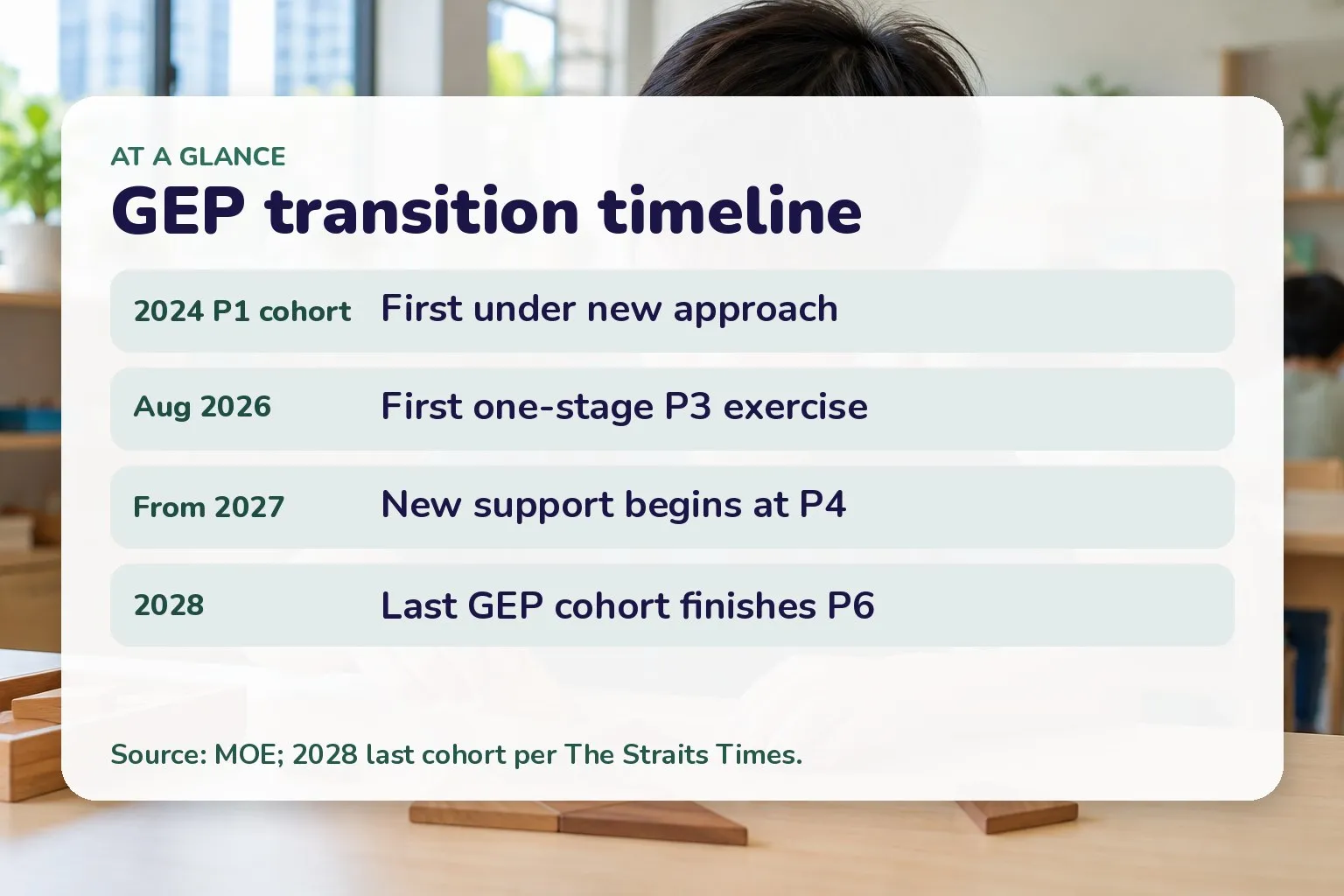
The transition, cohort by cohort. Source: MOE; last-cohort year corroborated by The Straits Times.
| When | What happens |
|---|---|
| 2024 Primary 1 cohort | First group identified under the new approach |
| August 2026 | First one-stage Primary 3 identification exercise |
| From 2027 | New support begins at Primary 4 (school-based and/or centre modules) |
| 2028 | The last pupils under the old GEP finish Primary 6 |
Can you prepare for it?
This is the question parents ask most, and the design of the new exercise is the answer.
A calmer, more useful approach is to let your child read widely, follow their curiosity and talk through problems — the habits the modules are built around — and to keep the exercise in proportion alongside the rest of choosing a primary school.
After primary: gifted support at secondary
The centralised GEP only ever ran at primary level in recent years. At secondary school, MOE moved from a centrally-run programme to School-based Gifted Education back in 2004, where schools stretch able students themselves, alongside centralised specialisation such as the Science Mentorship Programme and the Creative Arts Programme. So the primary change does not remove opportunities later — it brings the primary model closer to how secondary schools already work. For the talent- and interest-based programmes that run across schools, see our guide to MOE programmes: ALP, LLP and elective programmes.
GEP selection FAQ
Is there still a GEP test? There is still a standardised exercise in Primary 3, but only one stage now; the former second stage has been dropped, and teachers’ observations also count.
Will my Primary 3 child in 2026 still take a test? Yes — they are the first cohort to sit the new one-stage identification, held in August 2026.
Do identified children change schools? No. They stay in their own primary school and travel to a nearby designated centre only for after-school modules.
How many children benefit? Around 10% of the cohort through school-based provisions, up from about 7%, with the advanced modules open to more pupils than the old 1% GEP because they target specific strengths.
My child is in Primary 1 or 2 — what should I do? Nothing special. The identification happens in Primary 3; for now, focus on reading, curiosity and a settled start to school. For how registration itself works, see P1 registration phases.
General information based on MOE sources, not official guidance. Confirm the current identification process and dates with your child’s school and on moe.gov.sg.
Sources
- Learning Together with Different Strengths and Needs (press release) — Ministry of Education Singapore (as of October 2026)
- Strengthening Support for Higher-Ability Learners (press release) — Ministry of Education Singapore (as of October 2026)
- Gifted Education Programme (parliamentary reply) — Ministry of Education Singapore (as of October 2026)
- FAQ: Singapore's revamped Gifted Education Programme — Channel NewsAsia (as of October 2026)
- Post-GEP: high-ability pupils to attend advanced modules — The Straits Times (as of October 2026)